COACHES
Early motorcoaches
The first Royal Blue motorcoaches were two Dennis charabancs new in 1913. During the period up to 1935, the company bought various makes and model of coach, each getting larger, more powerful and giving greater passenger comfort. Chassis manufactures included ADC, AEC, Crossley, Daimler, De Dion, Leyland & Selden.
The first Royal Blue motorcoaches were two Dennis charabancs new in 1913. During the period up to 1935, the company bought various makes and model of coach, each getting larger, more powerful and giving greater passenger comfort. Chassis manufactures included ADC, AEC, Crossley, Daimler, De Dion, Leyland & Selden.
In 1935 Royal Blue took delivery of the first of four AEC 'Q' coaches. These were very futuristic - the engine was located on the offside of the coach, behind the front wheels!
After Royal Blue had been acquired by the Tilling Group in January 1935, their new coaches were of mainly Bristol chassis manufacture. The Bristol JJW being the type of this era.
Post-War Renewal
In 1948 & 1949 Royal Blue took delivery of 35 Bristol 'L' front-engined, half-cab 31-seat coaches with Beadle coachwork. For their time they were very luxurious.
HOD 30 (fleet no. 1228) is the oldest & only survivor of these coaches.
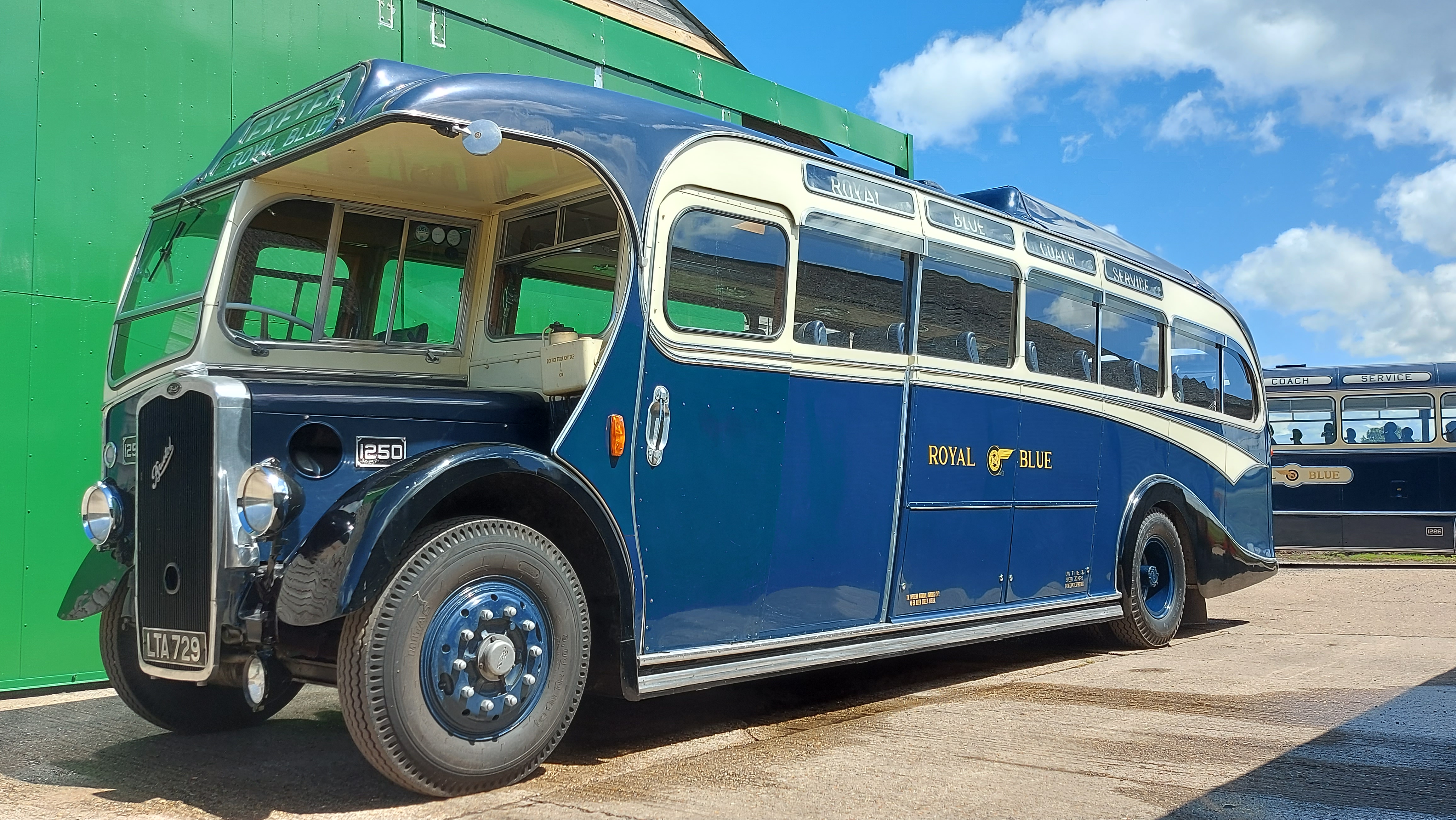
In 1950 Royal Blue bought 10 Bristol 'LL' (longer) front-engined, half-cab 37-seat coaches with Duple coachwork.
LTA 729 (fleet no. 1250) is a beautifully restored example of the 1950 coaches (pictured). Three more of these Royal Blue coaches survive: LTA 893 (unrestored); LTA 895 (being restored); LTA 898 (restoration completed August 2026).
Modernity
In 1952 Royal Blue bought their first modern coach - the Bristol 'LS' with Eastern Coach Works 41-seat body. These had an underfloor engine which meant, for the first time, the driver sat in the saloon with his passengers. Up to 1957 Royal Blue bought 36 of these.
MOD 973 (fleet no. 1286) is fabulously restored example (pictured). Note the luggage pen on the roof at the back - a feature of Royal Blue coaches from the mid-1920's up to 1953!
Six Royal Blue Bristol 'LS' coaches survive. Most are restored & on the road.
Their registrations: MOD 973; MOD 978; OTT 43; OTT 96; OTT 98; VDV 749.


Golden Age
In 1958 the 'LS' was replaced by the Bristol 'MW', also with Eastern Coach Works body. Royal Blue took 27 that year, all 41-seaters. In 1960 & 1961 Royal Blue bought another 28 'MW's, all 39-seaters.
56 GUO (fleet no. 2267) shows a late-1950's, early 1960's feature - windows in the roof cove. Ideal for sightseeing, but making the coach very hot on a sunny day!
Severn 'MW' coaches survive. Some are on the road. Their registrations:
XUO 721; XUO 722; 617 DDV; 625 DDV; 55-57 GUO.
Swinging Sixties
Eastern Coach Works revised the bodywork for the Bristol 'MW' chassis in 1962, to better reflect contemporary coach styling. Those built in 1963 & after, were a foot longer. Royal Blue took several batches of these coaches up to 1967.
Two 'MW' Royal Blue coaches with the more modern coachwork survive. Their registrations: 253 KTA; 766 MDV.
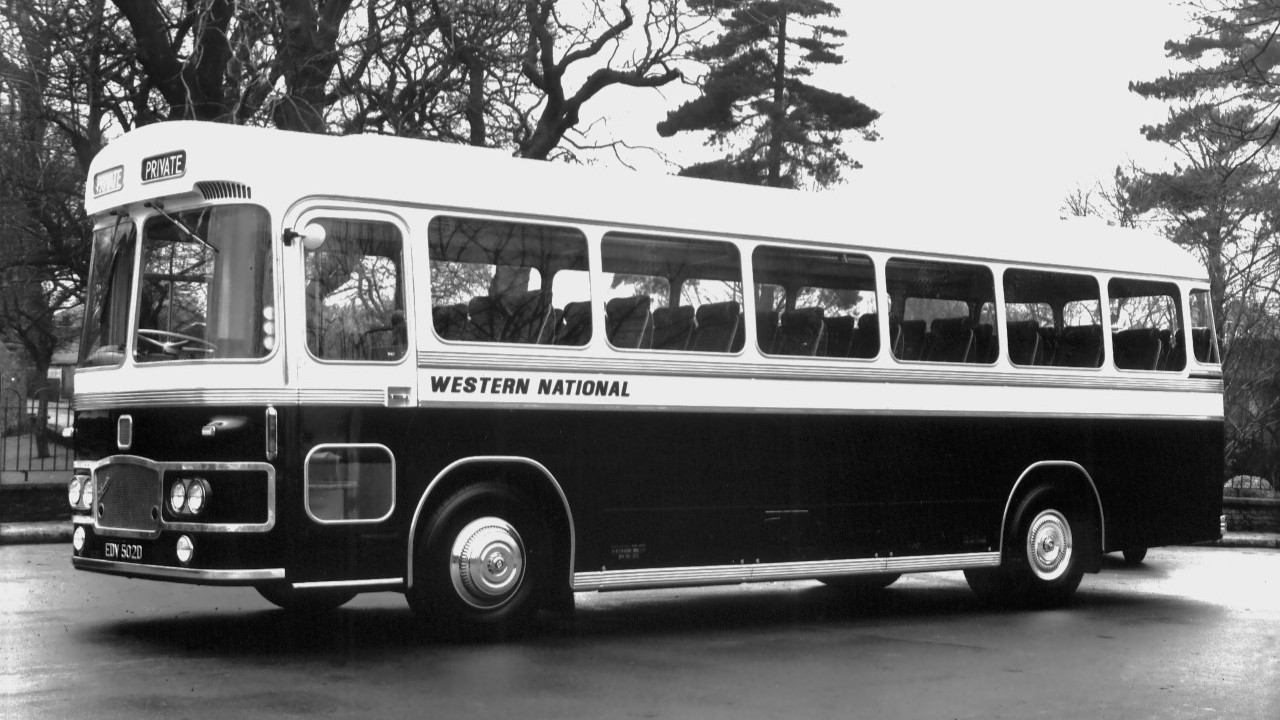
From 1963 all new coaches to Southern National & Western National were painted in the Royal Blue colour scheme, but did not wear the Royal Blue fleet name or have the interior specification. Pictured EDV 502D (fleet no. 1420) when new in 1966. Eight survivors from these coaches are: 759 MDV; EDV 502D; EDV 503D; EDV 505D; EDV 506D; HDV 634E; HDV 639E & HDV 641E.
Rear engine revolution
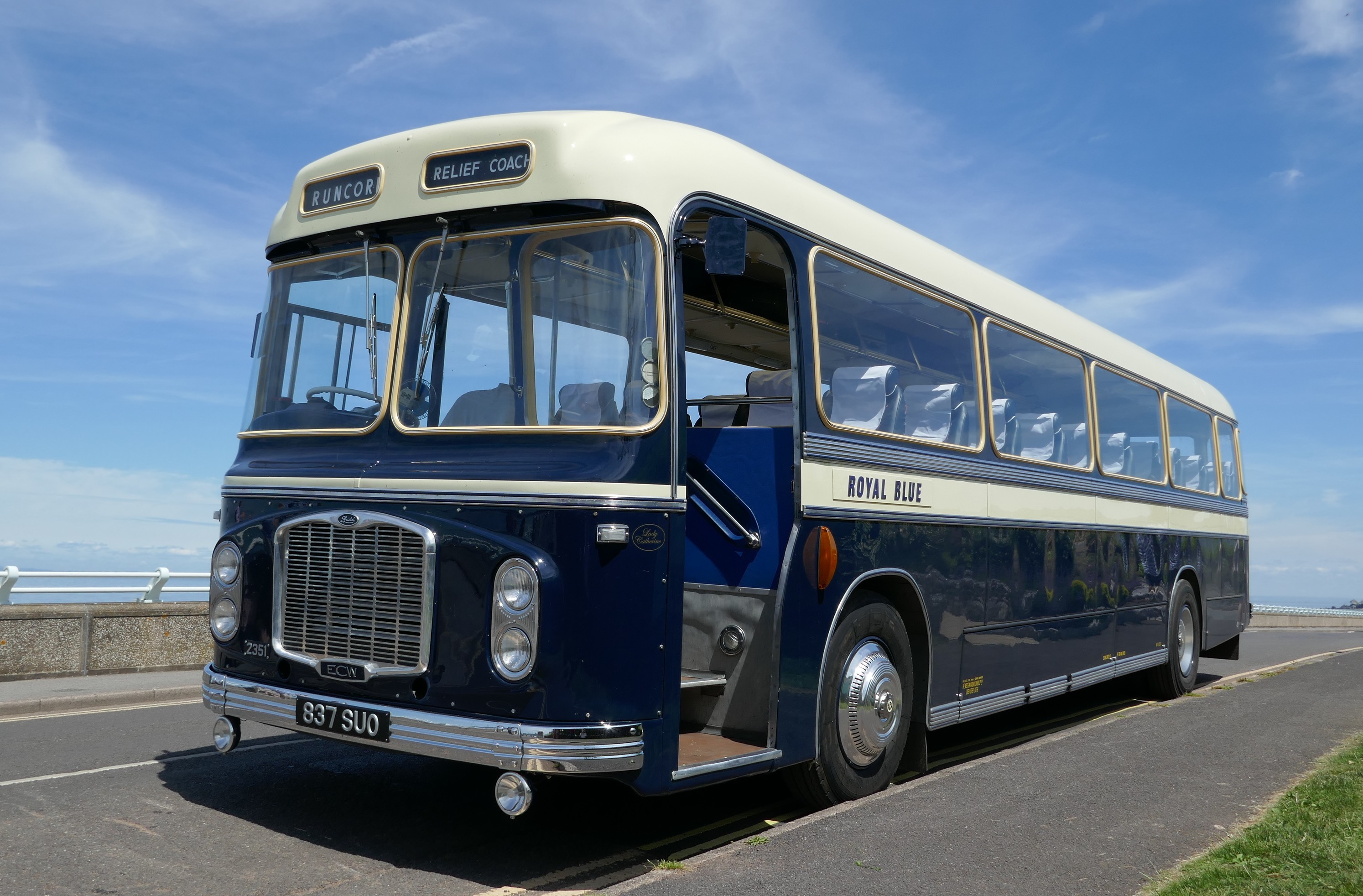
1964 was a landmark year for Royal Blue. They bought their first 6 Bristol 'RELH' 45-seat coaches with Eastern Coach Works bodies. They offered customers real swinging-sixties luxury - smooth air suspension, individual overhead reading lights & air vents. By June 1970 Royal Blue had 41 of these luxury coaches in service. A further 35, nearly identical coaches, were added to Western National & Southern National (in Royal Blue livery) between 1968 & 1970 for tours & excusions work (although they often worked express services).
837 SUO (fleet no. 2351) was the first RELH. It is now beautifully restored.
Five 'RELH' Royal Blue coaches survive. They're all restored & most are on the road. Their registrations: 837 SUO; HDV 624E; LDV 847F; OTA 640G & OTA 645G.
Five RELH/ECW coaches bought by Southern National & Western National that survive are: LDV 467F; OTA 632G; RDV 419H; RDV 423H & RDV 433H.
During the early 1970's Royal Blue also bought 30 Bristol RELH coaches with Plaxton coachwork. It is not thought that any of these survive.
Light & small
For routes operating around the narrow roads and lanes of Devon & Cornwall, Royal Blue needed coaches of smaller dimensions than those that were becoming the norm by the late-1960's. The Bristol 'LH' chassis meet this requirement.
BDV 318L (fleet no. 1318) an 'LH' with 39-seat coachwork by Marshall survives (pictured). Another, similar coach may survive - do you know? Please let me know.


Seventies
The standard NATIONAL coach of the 1970's & early-1980's was the Leyland Leopard chassis, with Plaxton coachwork.
FDV 803V (fleet no. 3547) was new in 1979 and is now preserved as the only known survivor. It proudly carries its 'Royal Blue' operator identity above the front wheelarch (in red vinyl - that's what the National brand manual specified!).